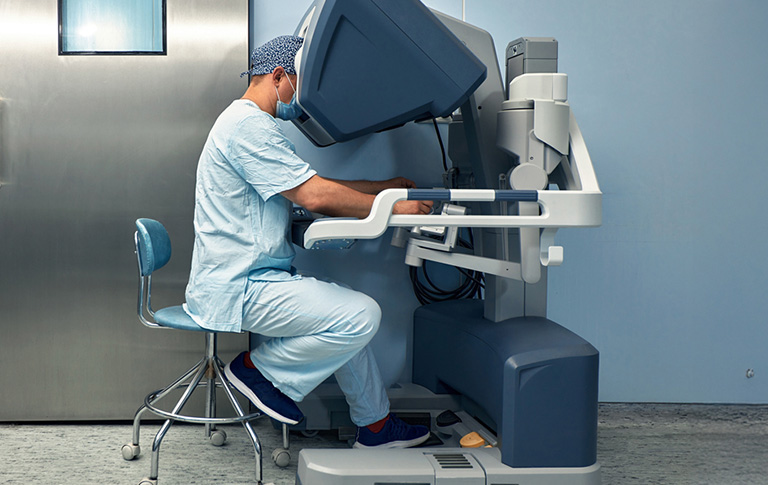

Far from being an autonomous robot performing your operation, robot-assisted surgery is more like an extension of your surgeon’s own hands. It enables higher precision movements of the tools, more complex manoeuvres, and a better definition view of your internal tissues during the procedure. Dr Reyftmann is pleased to be able to offer robotic surgery at IRML, an option not available at all fertility clinics due to the advanced training required to operate these systems effectively.
The concept of robotic surgery is not confined to reproductive medicine and gynaecology. It is used across a number of medical fields, including general surgery, urology, and cardiology. Within reproductive surgery and gynaecology, it is often used as an alternative to another valuable minimally-invasive procedure known as laparoscopy.
Robot-assisted surgery may be used for:
Robotic surgery is typically a day procedure under general anaesthetic. The complexity and duration of your operation will depend on what condition is being treated; Dr Reyftmann will discuss what to expect in the pre-operation stage.
A number of keyhole incisions are made in your belly to give access to the tools needed for your treatment. These tools are connected to robotic arms, which are connected to a specialised console with controls. These controls allow Dr Reyftmann to make tiny, precision movements with the instruments performing the operation in real-time. The monitor screen provides a magnified, high-definition, 3D view of the operation site.
Compared to laparoscopy (keyhole surgery) and conventional open surgery, robotic surgery enables:
Though the rate of complications is very low with robotic surgery, all surgical procedures come with a risk of bleeding and infection or unintentional damage to tissues. The fees associated with robot-assisted surgery tends to be higher than that with conventional laparoscopy due to the costs of the equipment. If you have a condition that may benefit from robot-assisted surgery, Dr Reyftmann will discuss your particular situation and your options for treatment.
