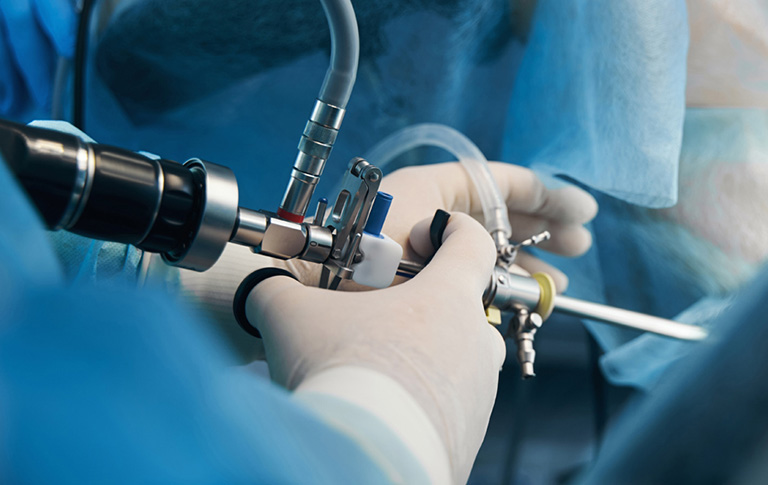

Hysteroscopy is a surgical procedure used to assess the inside of your womb for a number of gynaecological conditions that can impact fertility. It involves no incisions as the hysteroscope – a thin telescope-like device with a light source and a camera – is inserted via your cervix to examine the uterus, providing valuable information about its health. Surgical instruments can also be introduced into your womb through the hysteroscope to perform surgical procedures.
A hysteroscopy is specifically designed to examine the inside of your womb. Though an ultrasound scan can also be used to assess the health of your womb and is suitable for certain situations, a hysteroscopy provides much more detail. This technique sends a live image to a connected monitor so that Dr Reyftmann can identify any abnormalities and make a decision on treatment. Hysteroscopy can also be used for treating certain uterine disorders.
The hysteroscopy procedure is useful for:
Hysteroscopy is a day procedure, meaning it is not expected that you should need to stay in hospital overnight. It can be performed under either local anaesthesia (to numb your cervix) or under general anaesthesia, which largely depends on your personal preference and what Dr Reyftmann thinks would be best for you in his experience. Some women feel comfortable to proceed with a hysteroscopy without any anaesthesia at all and just need to take over-the-counter painkillers before their procedure.
The hysteroscope is inserted through your cervix into your womb, meaning no incisions are required. The light and camera at its end send high-definition video to a monitor screen to allow a detailed examination of the inside of your womb, looking for any abnormalities. If a problem is found, Dr Reyftmann may take a biopsy (a small tissue sample) or perform surgical correction at the same time, such as removing a polyp or fibroid.
Recovery after a hysteroscopy is generally straightforward and uncomplicated. You may return to your normal daily activities on the same day if you feel able, otherwise you may prefer to rest for a few days, especially if you had surgical treatment combined with the diagnostic hysteroscopy. It’s normal to experience some mild period-like abdominal cramping and spotting. Dr Reyftmann will provide you with post-operative instructions for your hysteroscopy recovery.
As a minimally-invasive technique, hysteroscopy will always have a benefit over more invasive surgeries that aim to accomplish the same thing. Advantages of hysteroscopy include:
Serious complications are very rare with hysteroscopy, though the risk is higher if surgical treatment is performed compared to just using hysteroscopy for diagnosis. Potential complications include infection, excessive bleeding, or accidental trauma to the uterus or cervix during the procedure. All of these problems can be managed either through antibiotics or another surgical procedure, but are highly unlikely to occur.
