
At IRML, we understand the frustration and hopelessness you feel after each negative pregnancy test. Dr Reyftmann offers comprehensive fertility testing for women who are yet to see that double line. His gentle approach and diligence in investigations will give you confidence that your reproductive health is in good hands.
Age is the single most important factor when determining a woman’s reproductive potential.
Women don’t produce any more eggs than what they’re born with. Over time, with age, these eggs decline in number and quality, making it progressively less likely to fall pregnant naturally as you get older. Female fertility and reproductive potential drops significantly after age 45. Though it is still possible to conceive naturally in your older years (before menopause begins), the risk of pregnancy complications and passing on a genetic defect are higher compared to pregnancies in women aged in their 20s and 30s.
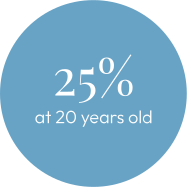
At age 20, a healthy woman has approximately a 25% chance of getting pregnant each month
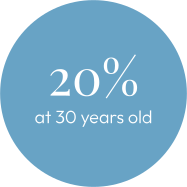
At age 30, a healthy woman has approximately a 20% chance of getting pregnant each month

At age 35, a healthy woman has approximately a 15% chance of getting pregnant each month
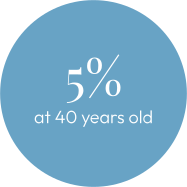
At age 40, a healthy woman has approximately a 5% chance of getting pregnant each month
Female infertility causes as the sole factor are implicated in around 30% of couples experiencing conception challenges. Other than increasing age, infertility in women can be a result of certain conditions or abnormalities. In some cases, no cause can be identified.
Ovulatory disorders often present as abnormal menstrual periods. Your menstrual cycle is a process of an egg maturing and being released from an ovary (ovulation), travelling down the fallopian tubes, and waiting there to be fertilised by a sperm cell. Part of this cycle also involves the lining of the uterus, the endometrium, thickening as it prepares for a potential pregnancy. If a pregnancy doesn’t happen that month, the endometrium breaks down and sheds from your body along with the unfertilised egg, what we call your menstrual period.
Abnormal periods can indicate there is an issue with ovulation. This might present as irregular periods, infrequent periods, abnormally heavy or painful periods, or not having a period at all. These disrupted cycles make it difficult to conceive also because it’s hard to time intercourse around ovulation when you can never be sure when (or if) it’s happening. Causes of abnormal ovulation can include polycystic ovary syndrome (PCOS), endometriosis, uterine fibroids, being underweight or overweight, physiological or emotional stress, and thyroid disorders.
Treating abnormal ovulation/menstruation relies on identifying the root cause. Once we have diagnosed this, we can regulate your cycles through medications or surgery, lifestyle modifications, or referral to another specialist such as for management of eating disorders or thyroid problems. Sometimes, fertility treatments such as ovulation induction or IVF may be necessary to help you on your way to building your family.
PCOS is a common cause of female fertility challenges, affecting around 8-13% of women of reproductive age in Australia. However, as many as 70% of women with PCOS go undiagnosed. At its root, PCOS is a hormone problem. It involves unusually high levels of androgens, which are typically considered a male hormone.
Elevated androgens are responsible for the more visible and distressing symptoms of PCOS – abnormal hair growth on the face, chest, and back, acne, hair thinning on the scalp, weight gain, skin tags and pigmentation. In addition to testing your blood for these hormonal abnormalities, PCOS can be identified through polycystic ovaries visible on ultrasound and having irregular or absent menstrual periods.
The abnormal hormone levels associated with PCOS can interfere with normal development of your eggs and ovulation. While this can contribute to infertility in some women, having PCOS does not automatically mean you will be unable to conceive naturally. We can treat PCOS through medications and lifestyle changes that help to regulate your hormones. Often this will be enough to allow you to fall pregnant naturally. If necessary, we can also consider fertility treatments such as IVF or IUI.
Problems with anatomical structures in your reproductive system can cause problems with falling pregnant or maintaining a pregnancy. These can include an obstruction of your fallopian tubes or fibroids, polyps, or congenital malformations of the uterus (womb).
A blockage of your fallopian tubes will make it physically difficult for an egg to travel to the uterus or for sperm to meet the egg for fertilisation. This may be due to inflammation (often due to sexually transmitted infections such as chlamydia), a congenital abnormality, a previous contraceptive procedure (tubal ligation to “tie your tubes”), or trauma from surgery. Scarring and adhesions involving the fallopian tubes from severe endometriosis or pelvic inflammatory disease can also cause problems. Around 20% of female infertility is due to an issue with the fallopian tubes.
Uterine disorders can increase the risk of infertility and miscarriage. These conditions include uterine fibroids (benign growths on and in the wall of the uterus), polyps (benign growths on the inside surface of the uterus), a septate uterus (an abnormal division or wall formed inside the uterus), or scarring from trauma or infection. All these situations can make it difficult for an egg to implant within the uterine lining and progress through a pregnancy.
Most structural problems of the fallopian tubes and uterus can be fixed with advanced reproductive surgery.
Endometriosis is a common gynaecological condition, affecting around 1 in 9 women in Australia. Despite it being so prevalent, it can take years to properly diagnose. This condition involves tissue similar to that of the endometrium, which normally lines the uterus, growing outside of the uterus. Common locations of this abnormal tissue growth can include the fallopian tubes, ovaries, and behind the uterus.
The endometrial cells respond to your monthly hormones that signal your menstrual period. This results in the abnormal tissues outside your uterus breaking down and trying to shed from the body each monthly cycle. In addition to causing chronic pelvic and abdominal pain, endometriosis is associated with heavy or irregular periods, disturbance to your urination or bowel movements, abdominal bloating, and difficulty conceiving.
Over time, the repeated inflammation caused by endometriosis can result in scarring and adhesions to the structures affected by the abnormal tissue growth, which can result in difficulties falling pregnant. To manage infertility related to endometriosis, Dr Reyftmann may recommend laparoscopic (keyhole) surgery to remove the endometriosis or adhesions and increase your chances of natural conception, or assisted reproductive technologies such as IVF.
While many causes of female infertility relate to disease and injury outside your control, many of your lifestyle choices and behaviours can also contribute to your reproductive health. Lifestyle factors that have been shown to be associated with female infertility include smoking, illicit drug use, alcohol consumption, caffeine consumption, and being over or underweight.
