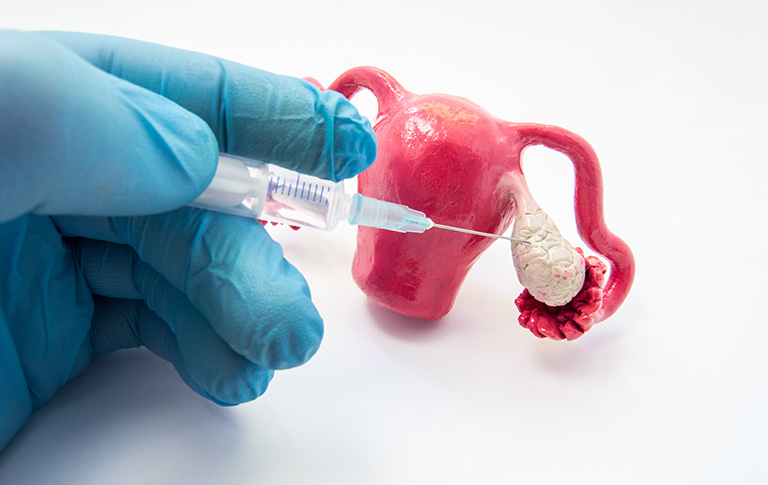
Commonly abbreviated to OI, ovulation induction is a sensible alternative fertility treatment to the more invasive and costly IVF procedure for certain patients. This approach still gives you the opportunity of making a baby the good old fashioned way, but improves your chances of conception through controlling the timing of ovulation. OI can also be combined with intrauterine insemination (IUI).
For fertilisation to happen naturally, a sperm cell needs to meet an egg. However, a woman’s egg isn’t available at just any time. Ovulation is the time of a woman’s cycle where a mature egg has been released from your ovaries and waits in the fallopian tubes. If your cycle length is the standard month, ovulation typically occurs halfway through the cycle (roughly two weeks before your next menstrual period). Having intercourse at this moment, or within a few days either side of ovulation, is when it’s possible to fall pregnant. We call this the fertile window.
Dr Reyftmann will prescribe a hormone medication in the form of either an injection or oral tablet. These medications are typically taken at the beginning of your menstrual cycle and signal your ovaries to release and mature more eggs.
Common ovulation induction medications include PuregonⓇ and Gonal FⓇ (follicle stimulating hormone), letrozole, and OvidrelⓇ (human chorionic gonadotrophin). We will monitor your progress through blood tests and ultrasounds.
Your blood tests and ultrasounds allow us to determine your fertile window and when you’re about to ovulate. The fertile window is a period of around 6 days.
During your fertile window, Dr Reyftmann typically recommends you have intercourse every second day to maximise your chances of conception. This approach is known as timed sexual intercourse.
A lot of fertility treatments involve waiting – waiting for your body to respond to the medications and now waiting (and hoping) that fertilisation and implantation have taken place.
Around the 2-week mark after your fertile window, we can organise a pregnancy blood test for you. You could also take a urine pregnancy test at home, but this test is less sensitive and can be confused by the hormone medications, so we recommend waiting for your blood test.
Ovulation induction is typically recommended if ovulation disorders are contributing to your fertility concerns. It would not be suitable for couples who are affected by sperm-related male infertility, as the OI approach requires healthy sperm to be able to find the egg and fertilise it on their own.
Dr Reyftmann may recommend OI if you are affected by:
OI is also often used to enhance the intrauterine insemination procedure, making the timing more predictable for the insemination phase.
